
By Mason Brown
The equipment is in place. The project timeline is locked. Then someone walks the site and says the words nobody wants to hear: “The crane can’t get to it from here.”
That moment, when overhead access is blocked, floor loads won’t support outriggers, or the clearance is simply too tight, is exactly where most rigging plans fall apart. And it’s where the difference between a qualified rigging contractor and a capable-looking one becomes very expensive, very fast.
Direct Answer
Hydraulic jacking and rigging systems move extremely heavy equipment in confined or structurally restricted spaces where cranes can’t operate. Using synchronized hydraulic jacks, skid tracks, and gantries, trained riggers lift, shift, and reposition loads that would otherwise require full facility shutdowns or structural modifications. The right contractor brings engineered lift plans, site-specific equipment, and the personnel to execute safely.
Key Takeaways
- Hydraulic jack-and-slide systems are the correct tool when overhead crane access is blocked, floor load limits are exceeded, or clearances are too tight for conventional lifting equipment
- A formal lift plan isn’t optional paperwork. It’s the document that prevents a catastrophic load failure and protects your project from OSHA liability
- The biggest cost in a confined-space rigging job isn’t the contractor’s day rate. It’s the downtime that compounds when the wrong approach fails mid-move
- Not every rigging company carries hydraulic gantry systems, skid systems, and jacking equipment in-house. Confirm the fleet before you sign the contract
- H. Brown, Inc. has operated across the Gulf South since 1938, with equipment and trained personnel for moves that conventional crane service can’t touch
Why Does the “Crane Can’t Get There” Problem Keep Happening on Industrial Sites?
You’ve probably seen it on a refinery turnaround, a power generation facility, or a plant expansion: the equipment that needs to move is surrounded by pipe racks, low ceilings, live process lines, or a floor that simply won’t hold outrigger loads. The crane that worked perfectly on the last job is useless here.
This isn’t a planning failure. It’s a geometry problem that most project timelines don’t budget for.
Industrial facilities are built around process flow, not equipment replacement. When a heat exchanger, turbine, transformer, or compressor needs to come out for maintenance or replacement, the path it has to travel often runs through the most congested part of the plant. The equipment that was installed during original construction went in before the surrounding infrastructure existed. Getting it out is a different problem entirely.
The assumption that a crane is always the answer is the single most expensive mistake in industrial rigging planning.
What Actually Is a Hydraulic Jack-and-Slide System, and When Does It Replace a Crane?
A hydraulic jack-and-slide system is a ground-level rigging method that uses synchronized hydraulic jacks to lift a load incrementally, then slides or skids it horizontally along a pre-engineered track or beam path.
The system works because it distributes load across a larger footprint than a crane’s outrigger pads, which means it can operate on floors and surfaces that would fail under conventional crane loading. It doesn’t require overhead clearance. It doesn’t need a clear swing radius. And it can move loads that exceed what any mobile crane in the region can lift, because the capacity is a function of how many jacks you deploy, not a single mechanical limit.
You can read more about how these systems work in practice on H. Brown’s hydraulic jack-and-slide systems page, and their piece on hydraulic jack-and-slide as a crane alternative breaks down the comparison clearly.
The honest answer on when to use it: any time the crane path is blocked, the floor can’t support outrigger loads, overhead clearance is under roughly 20 feet, or the load needs to travel horizontally through a building rather than straight up and out.
The Lift Plan Question Nobody Asks Until It’s Too Late
Here’s where projects get into real trouble. A rigging contractor shows up with the right equipment but without a formal, site-specific lift plan, and the move proceeds on experience and instinct rather than engineering.
A lift plan is a documented, engineered analysis of the load weight, center of gravity, rigging geometry, equipment capacities, floor or ground bearing capacity, and the step-by-step sequence of the move. It accounts for dynamic loading during the lift, not just static weight.
OSHA’s rigging and crane standards require lift plans for critical lifts, and most industrial facilities have their own permit requirements on top of that. But the real reason to demand one isn’t compliance. It’s that a lift plan is the only document that tells you, in advance, whether the move you’re planning is actually executable without catastrophic risk.
Brown, Inc. develops formal rigging lift plans as a standard part of their process, not an add-on. That’s the difference between a contractor who can move the load and one who can move it safely and repeatably.
If you’re evaluating rigging contractors and one of them doesn’t mention a lift plan until you ask, that’s your answer.
A Typical Confined-Space Rigging Scenario: What the Move Actually Looks Like
Consider a situation common across Gulf Coast petrochemical facilities: a large pump skid, weighing several hundred tons, needs to be moved from its operating position to a staging area inside a process building for a major overhaul. The ceiling height is 18 feet. The floor is reinforced concrete with a rated load capacity that a mobile crane’s outrigger pads would exceed. Pipe racks and live electrical runs border three sides of the travel path.
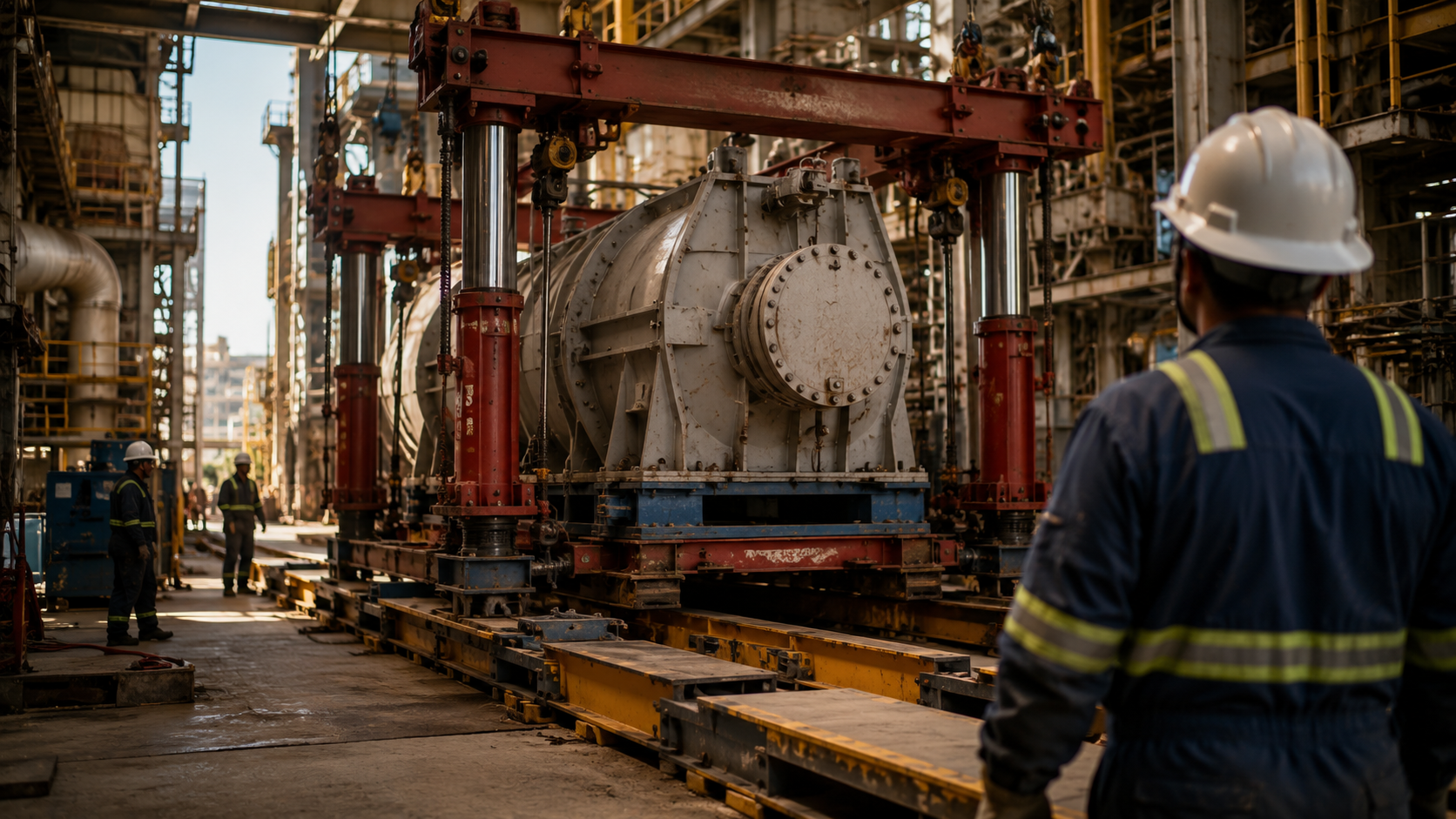
A mobile crane is out. A forklift can’t handle the weight or the precision required. The right answer is a hydraulic gantry system running on ground-level tracks, with the load suspended between the gantry legs and walked incrementally along the planned path.
The move requires a surveyed travel path, engineered track placement, synchronized hydraulic controls, and a crew that’s done this before in similar conditions. The total move might cover 60 feet. It might take two days. Done right, the facility never shuts down the adjacent process units.
Done wrong, the consequences aren’t a delay. They’re structural damage, equipment loss, and the kind of incident report that follows a project manager’s career.
The many benefits of hydraulic jack-and-slide systems go beyond just confined spaces. They’re also the right call when you need precision positioning that a crane hook simply can’t deliver.
How Do You Evaluate a Rigging Contractor Before the Job Starts?
The contractor who wins on price and shows up without the right equipment costs you more than the contractor who quoted higher and brought everything needed.
Here’s a practical comparison of what separates a qualified confined-space rigging contractor from one who’s capable on straightforward jobs but out of their depth on yours:
|
Evaluation Factor |
Qualified Confined-Space Rigger |
General Rigging Contractor |
|
Hydraulic gantry systems |
Owns and operates in-house |
Rents when needed, may not have access |
|
Lift plan documentation |
Engineered and site-specific, standard practice |
Provided on request, may be generic |
|
Floor-load engineering |
Calculates and documents bearing capacity |
Relies on contractor’s verbal confirmation |
|
Personnel certification |
NCCCO or equivalent, documented |
Variable |
|
Multi-industry experience |
Petrochemical, power, nuclear, utilities |
May be construction-focused only |
|
Equipment capacity range |
Scales from small precision moves to 500+ tons |
Limited upper range |
|
Lift plan for critical lifts |
Always |
Sometimes |
Brown, Inc.’s professional heavy lifting and rigging services cover this full range, with trained and insured personnel, well-maintained equipment, and the in-house capacity to handle jobs from straightforward picks to multi-day confined moves.
If you’re in the planning phase of a project that involves any of these conditions, the time to confirm your rigging contractor’s actual capabilities is before the scope is finalized, not after the equipment is locked in.
Contact H. Brown, Inc. to discuss your project specifics and get a clear picture of what the move actually requires.
What About Situations Where a Crane Is Still the Right Answer?
Hydraulic rigging systems don’t replace cranes. They handle the jobs cranes can’t.
When you have clear overhead access, adequate ground bearing, and a lift that goes straight up and out, a mobile crane is faster, simpler, and often more cost-effective for that specific move. H. Brown, Inc.’s crane rental and service fleet runs from 10 to 500 tons, covering the full range of what Gulf South industrial projects typically require.
The real skill is knowing which tool fits the job. A contractor who only owns cranes will find a way to use a crane. A contractor who carries both systems will tell you which one actually works.
The lift-n-lock hydraulic gantries H. Brown operates are a good example of equipment that bridges the gap: versatile enough for precision positioning, capable enough for heavy industrial loads, and deployable in spaces where a crane is simply not an option.
Who Is This Type of Rigging NOT Right For?
Hydraulic jack-and-slide and confined-space rigging is not the right approach for every project. Be honest about this before you commit resources.
If your load is under 10 tons, has clear crane access, and the move is a single vertical lift with no horizontal travel required, a standard crane pick is faster and simpler. Don’t over-engineer a straightforward job.
Hydraulic rigging systems also require a pre-surveyed, prepared travel path. If your site conditions don’t allow for track placement or the floor surface can’t be prepped, the system can’t perform as designed. That’s a site constraint, not a contractor limitation.
And if your project timeline doesn’t allow for the engineering review and lift plan development that a critical confined-space move requires, you’re not ready to execute the move safely. Rushing the plan to hit a schedule is how incidents happen.
The right contractor will tell you all of this before you sign anything.
Your Project Deserves a Contractor Who’s Done This Before
Brown, Inc. has been moving what others can’t move since 1938. Family-owned and operating across the Gulf South from Texas to Florida, the team brings in-house hydraulic gantry systems, jack-and-slide equipment, and cranes up to 500 tons, along with the trained and insured personnel to use all of it correctly.
If you’ve got a confined-space move, a hard-to-access piece of equipment, or a project where the standard approach isn’t going to work, that’s exactly the kind of problem H. Brown was built for. Hook it, jack it, slide it, push it, pull it, roll it, haul it.
Reach out to the team at H. Brown, Inc. to talk through what your project actually requires. No guesswork, no overselling. Just a straight answer on what the job takes and whether they’re the right fit for it.
About the Author
Mason Brown is part of the team at H. Brown, Inc., a Louisiana-based industrial services company specializing in crane rentals, heavy hauling, rigging, and specialized transportation. H. Brown has served the Gulf Coast industrial, petrochemical, commercial construction, and energy sectors since 1938, providing complex lifting and transportation solutions for projects of all sizes. The company operates out of Eunice, Louisiana, serving the Gulf States from Texas to Florida and beyond.