
By Mason Brown
When you’re planning a heavy lift or equipment move and the schedule is already tight, the last thing you need is to commit to a method and find out halfway through that it was the wrong call. The choice between rigging, crane lifting, hydraulic jacking, and other alternatives isn’t always obvious, and getting it wrong doesn’t just cost money. It costs time, equipment, and sometimes safety.
Rigging is the right answer for most heavy industrial lifts, but not all of them. When overhead clearance is limited, when a load needs to travel horizontally through a confined space, or when the ground can’t support a crane’s outrigger loads, alternatives like hydraulic jack-and-slide systems or gantries often outperform a crane lift entirely. The method you choose should follow the site conditions, not the other way around.
Key Takeaways
- Rigging with a crane is the fastest and most versatile method for open-site lifts, but it requires adequate overhead clearance and ground bearing capacity.
- Hydraulic jack-and-slide systems are the right call when a load must move horizontally through a structure with no overhead access.
- Gantry systems offer crane-like vertical lift in spaces where a mobile crane can’t physically fit.
- The most expensive decision isn’t picking the “premium” method. It’s picking the wrong method and discovering it on the day of the lift.
- Every method requires a formal lift plan. The complexity of that plan scales with the risk, not with your schedule.
What Does “Rigging” Actually Mean in an Industrial Context?
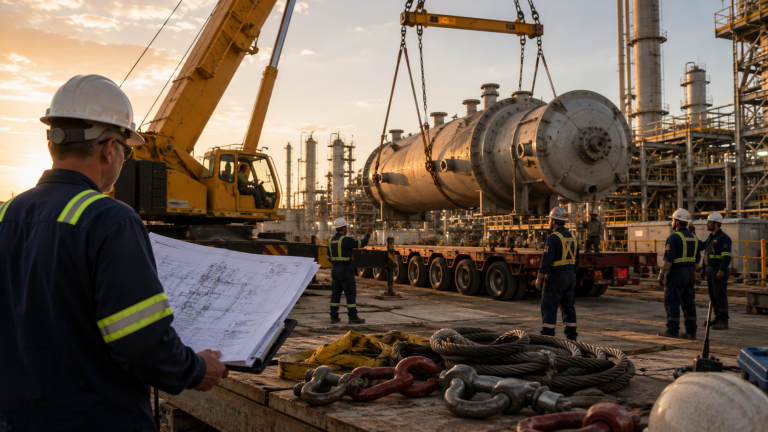
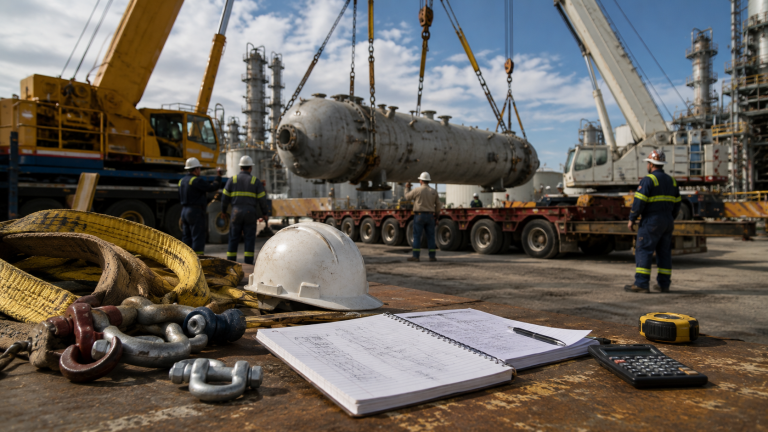
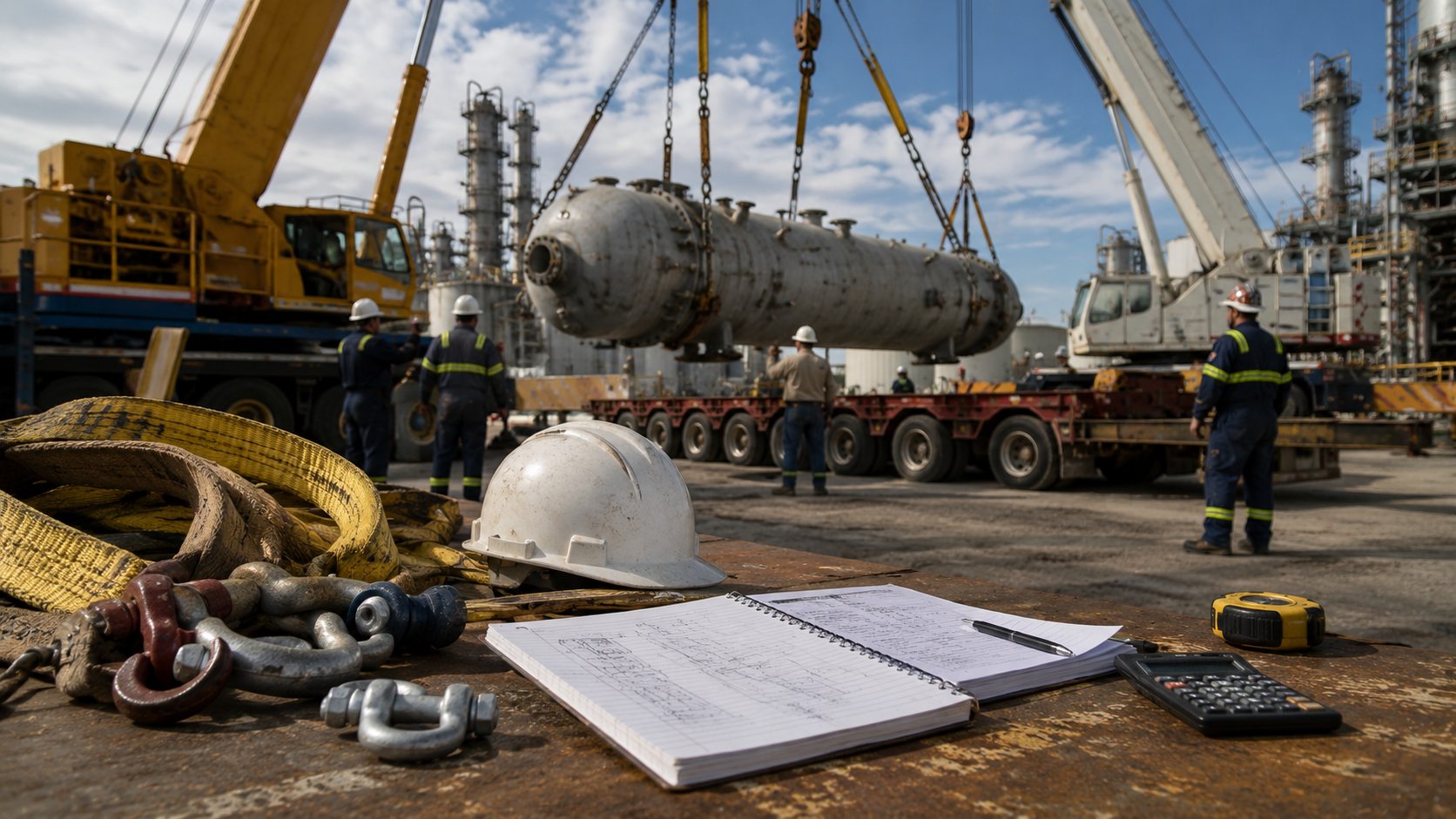
Rigging is the system of hardware, slings, chains, shackles, and rigging gear used to connect a load to a lifting device. The rigging doesn’t do the lifting. It transfers the load to whatever is doing the lifting, whether that’s a crane, a gantry, or a hydraulic system.
That distinction matters operationally. When people say “we need rigging for this job,” they usually mean they need the whole package: the lift plan, the equipment, and the trained personnel to execute it safely. H. Brown, Inc.’s professional heavy lifting and rigging services cover exactly that, from the initial site assessment through the final placement.
The rigging hardware itself is only as good as the plan behind it. A rigging lift plan accounts for load weight, center of gravity, sling angles, and the rated capacity of every component in the system. Skip any one of those, and you’ve got a liability problem, not a rigging plan.
When Is a Crane the Right Tool?
A mobile crane is the fastest way to move a heavy load vertically and place it precisely, assuming the site allows it.
The conditions that favor a crane lift are specific:
- Adequate overhead clearance above the load’s final position
- Ground bearing capacity sufficient for outrigger loads (which can be substantial on larger cranes)
- A clear swing radius with no obstructions
- A load that needs to travel vertically, not just horizontally
The crane is the right answer when the site is open, the overhead is clear, and speed matters. When any of those conditions aren’t met, you need to look at what else is available.
When Rigging Alone Isn’t Enough: The Case for Hydraulic Jack-and-Slide
Here’s the contrarian position: a crane is not the default correct answer for heavy industrial moves. It’s the default familiar answer, which is a different thing entirely.
A hydraulic jack-and-slide system is a method that uses synchronized hydraulic cylinders to lift a load incrementally and then move it horizontally along a track or skid system. It’s the right call when:
- The load is inside a building or structure with no crane access
- The load must travel horizontally through a confined space
- Ground conditions can’t support crane outrigger loads
- The load is too large or awkwardly shaped to rig conventionally
Consider a typical scenario in a petrochemical plant: a large heat exchanger needs to be repositioned inside a process unit. The overhead structure prevents any crane from reaching the load. The floor is a reinforced concrete slab, but the outrigger point loads from a crane would exceed the slab’s capacity. A jack-and-slide system lifts the exchanger off its supports, moves it along a temporary track, and sets it in the new position without ever needing overhead access.
Brown, Inc. has covered the mechanics and applications of this method in detail on their hydraulic jack-and-slide systems page. The benefits of hydraulic jack-and-slide systems are real, but they’re conditional. The system earns its place when the site conditions demand it, not as a cost-cutting substitute for a crane on jobs where a crane is the right tool.
The Method Selection Framework: Four Conditions That Drive the Decision
The “Right Method Matrix” is a four-condition decision tool for selecting the correct heavy lift method before committing to equipment and personnel.
Use it this way. For each of the four conditions below, answer yes or no:
Condition | Crane Lift | Jack-and-Slide | Gantry | Heavy Haul Only |
Overhead clearance available | Required | Not required | Not required | N/A |
Load travels vertically | Primary use | Secondary | Primary | No vertical move |
Load travels horizontally | Limited | Primary use | Limited | Primary use |
Confined or indoor site | Rarely works | Works well | Works well | N/A |
Ground supports outrigger loads | Required | Not required | Moderate | Not required |
If you’re scoring two or more “not required” conditions for a crane, you’re looking at the wrong method. That’s not a knock on cranes. It’s just site reality.
Gantries occupy a specific middle ground: they provide vertical lift capacity in spaces where a mobile crane can’t fit, and they’re modular enough to be assembled inside a structure. H. Brown, Inc.’s Lift-N-Lock hydraulic gantries are a practical option for exactly these situations.
What About Heavy Hauling? Where Does That Fit In?
Heavy hauling is not a lifting method. It’s a transportation method.
The confusion comes from the fact that most large equipment moves require both: a lift to get the load onto the transport, and a haul to move it to the new location. Treating them as separate decisions is where project managers run into trouble.
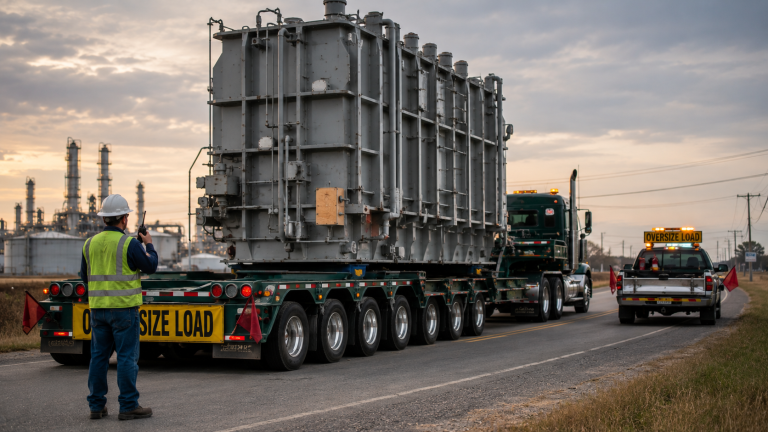
A common scenario: a power generation facility needs to move a transformer from a rail offload point to the substation, roughly a quarter mile away. The lift to set the transformer on the transport is a crane job. The move itself is a heavy hauling and transportation job, requiring permitted wide-load routing, pilot vehicles, and the right trailer configuration for the load’s weight and dimensions.
Separating the two contracts to save money often costs more in coordination delays than the savings justify. H. Brown, Inc. handles both, which means the lift plan and the haul plan are coordinated from the start rather than handed off between two vendors who’ve never spoken.
If your load qualifies as an over-dimensional haul, the wide load shipping services and pilot vehicle requirements pages cover what you’ll need for permitted moves across the Gulf States from Texas to Florida.
The Real Cost of Choosing the Wrong Method
The most expensive lift is the one that has to be redone.
Method selection errors don’t usually show up as a single catastrophic failure. They show up as schedule delays when the crane can’t reach the load, as ground preparation costs that weren’t in the budget, or as a second mobilization when the first method turns out to be wrong for the site.
When you’re planning a critical lift, the stakes are higher because the tolerance for error is lower. A critical lift is any lift where the risk of failure has consequences beyond the immediate load, including personnel safety, adjacent equipment, or structural integrity. These lifts require a separate, more detailed lift plan and a higher level of rigging oversight.
The right method, chosen before mobilization, is the cheapest method. That’s not a principle. That’s the operational reality of every project manager who’s had to explain a second mobilization cost to a client.
Who Should Handle the Method Selection?
Not the equipment vendor. Not the procurement department working from a spec sheet. The method selection has to come from someone who has seen the site, knows the load characteristics, and has run enough of these jobs to recognize when the standard approach won’t work.
Brown, Inc. has been doing this since 1938, working across oilfield, petrochemical, utilities, construction, demolition, and power generation projects throughout Louisiana and the broader Gulf Coast. The equipment fleet is only part of what you’re hiring. You’re hiring the judgment that comes with 85 years of family-owned field experience.
If you’ve got a lift coming up and you’re not certain which method fits the site, reach out to the H. Brown, Inc. team before you commit to equipment. A conversation before the job is free. A second mobilization isn’t.
Contact H. Brown, Inc. to discuss your project and get a straight answer on which method fits your site conditions.
What Rigging Can’t Do (And What That Means for Your Planning)
Rigging doesn’t solve access problems. It solves connection problems.
If the site doesn’t allow a crane to position over the load, rigging hardware won’t change that. If the ground can’t support the lift, no sling configuration fixes the problem. Rigging is the interface between the load and the lifting device. The lifting device still has to be able to reach the load.
This is worth stating plainly because it’s where project planning most often goes wrong. A team specifies rigging hardware, gets a price, and assumes the lift is planned. The rigging is one component of a system. The system only works when every component, including site access, ground conditions, overhead clearance, and load geometry, has been accounted for.
Brown, Inc. also offers rigging services for utility projects, which tend to involve the most constrained site conditions of any sector. If you’re working in utilities and the site is anything other than open and flat, the method selection conversation is the first conversation you should be having.
When the lift goes right, nobody talks about the method selection. When it goes wrong, that’s the first question everyone asks. Choose the method that fits the site, not the one that’s most familiar, and bring in people who’ve seen enough jobs to tell the difference.
Talk to H. Brown, Inc. about your next project and get a straight answer before you commit.
About the Author
Mason Brown is part of the team at H. Brown, Inc., a Louisiana-based industrial services company specializing in crane rentals, heavy hauling, rigging, and specialized transportation. H. Brown, Inc. has served the Gulf Coast industrial, petrochemical, commercial construction, and energy sectors since 1938, providing complex lifting and transportation solutions for projects of all sizes.